
The Battle Of Parvat Ali
Total View : 11 Date 29 Dec 2025
The Battle Of Parvat Ali
The Battle of Parvat Ali (1971 Indo–Pak War)
By Cadet Sanskruti More
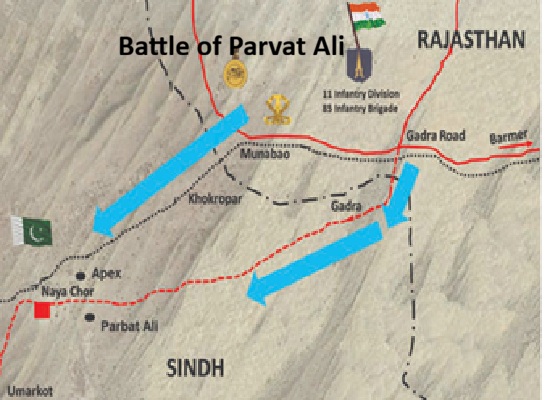
The Battle of Parvat Ali was one of the fiercest and most demanding engagements fought by the Indian Army during the 1971 Indo–Pak War. It formed part of Operation Cactus Lily, the Indian Army’s campaign in the Western Sector. The battle was fought on the night of 12–13 Dec 1971 in the harsh terrain of the Thar Desert, approximately seventy kilometres inside territory held by Pakistani forces, near the town of Naya Chor in Sindh.
Background and Objectives
Naya Chor was a vital Pakistani military and logistics centre in the Sindh sector. Its capture would seriously disrupt Pakistani lines of communication and weaken their defensive posture in the region. However, before advancing towards Naya Chor, Indian forces were required to secure Parvat Ali, a dominating sand feature overlooking the surrounding desert. The feature had been heavily fortified by the Pakistani Army and was held by elements of 21 Frontier Force.
The task of capturing Parvat Ali was assigned to 10 Sikh and 2 Mahar, both infantry battalions known for their fighting spirit and resilience. The objective was to clear the enemy defences on the feature and open the route for further advance.
Challenges of the Battle
The attack was carried out under extremely difficult conditions. The Pakistani defences included deep and wide minefields, well-sited bunkers, and automatic weapons. The terrain consisted of loose sand dunes that made movement slow and exhausting. Severe shortages of water, food and rest, combined with the cold desert night, added to the hardships faced by the Indian troops.
Despite these obstacles, the Indian assault parties advanced methodically through the minefields. As the fighting intensified, the battle turned into brutal close-quarter combat, involving bayonets, grenades and rifles, fought at point-blank range in darkness.
Acts of Gallantry
The battle witnessed exceptional courage and leadership. 2Lt Bahadur Singh of 10 Sikh displayed outstanding bravery while assaulting an enemy machine-gun position. Despite intense fire, he pressed forward and succeeded in neutralising the post before laying down his life. Maj Amrit Singh of 10 Sikh though wounded during the assault, continued to lead his men from the front, inspiring them to overcome fierce resistance and secure the objective. He was awarded Vir Chakra. Major Sushil Kumar Sarda of 2 Mahar, despite being severely wounded, fiercely defended his company against the enemy counterattack and was awarded the Vir Chakra for his gallantry.
Outcome and Significance
The Indian Army successfully captured Parvat Ali, forcing Pakistani troops to withdraw from their fortified positions. The victory came at a heavy cost, with fifty-seven Indian soldiers killed, while thirty-five Pakistani soldiers were taken prisoner of war. The capture of Parvat Ali opened the route for the advance towards Naya Chor, significantly strengthening India’s position in the Sindh sector.
For their valour and sacrifice, 10 Sikh and 2 Mahar were awarded the Battle Honour “Parvat Ali”, along with several Vir Chakras and Sena Medals to individual soldiers.
The Battle of Parvat Ali stands as a powerful example of the Indian Army’s courage, determination, and ability to fight and prevail under the most demanding conditions during the 1971 War.
Cadet Sanskruti More
Leviathan Battalion
YTA 10
© Yashotej Academy